
Turquoise carving
مهر
The art of turquoise carving in Isfahan is a combination of copper and turquoise stone. It is an art that is used to decorate jewelry, vases, candlesticks, plates and various containers, which in addition to its artistic and aesthetic value also has a significant material value. Isfahan Handicrafts Store
The art of turquoise carving, or popularly known as turquoise carving, is one of the original Iranian handicrafts whose turquoise stones captivate the eyes of every viewer at first glance and show them part of the beauty of art. If we want to examine the originality of the art of turquoise carving, we must say that this art is a combination of two professions, metalworking and stone carving, which have evolved from their original form and become a delicate and very beautiful art. In this art, delicate and very beautiful turquoise stones are placed on the surfaces of various metal objects, which are often made of relatively soft and resistant metals, leading to the creation of a very beautiful work of art.
The history of the formation of the art of turquoise carving, the general structure of this product, and such things can help you to purchase a high-quality and practical product before purchasing. But in general, regarding the art of turquoise carving, it is better to know that this art of storytelling is part of the history, taste, and culture of Iranian artists, which has manifested itself in this way today and has become one of the most popular arts in the world.
The art of turquoise carving is not very old, dating back to about 60 or 70 years ago, and it is one of the few handicrafts that does not have a long history. Today, the most important and main center of turquoise carving production, like many other isfahan handicrafts, is the city of Isfahan.
Turquoise carving in Isfahan
The substrate and background of the work play an important role in the production of turquoise carving products, and its flawlessness is as important as the correct placement of the turquoises, and it must be done correctly, otherwise it may be damaged during the various stages. The metal used must be uniform in all parts and have the same thickness. The parts where the turquoise pieces are placed should be about 2 to 3 mm lower than the rest of the parts. The background of turquoise carving containers or ornaments can be made of copper, brass, silver, Warsaw or bronze, which is mainly made of copper. Turquoise carving shop in Isfahan Copper products Turquoise
The turquoise used is often unusable turquoise pieces that are collected and purchased from turquoise carving workshops or turquoise mines in Mashhad and Neyshabur. Related words: Isfahan Turquoise Shop Nut Products Sweets Chocolate Simboldan Narrow Vase Sugar Craft Jar Rose Water Dispenser Hookah
Small pieces of turquoise are placed next to each other with special care and delicacy on the desired surfaces. In the stage of placing the turquoises on the desired surface, it is very important that the size of the selected turquoises is proportional to the desired surface.
Placing the pieces of turquoise on the dishes or ornaments is done by walnut varnish, which softens when heated and the artist can stick the turquoises to it. The artist needs a lot of care and patience to place the turquoises together because the more accurately the pieces of turquoise are placed together, the more uniform they are, and the less empty space between them, the higher their value and price.
After the installation stage of the turquoises is completed, the surface of all of them is made uniform by means of a sandpaper and polishing is done. At this stage, the turquoise color of the stones becomes visible. The surface of the turquoise becomes even with the container or substrate, and the metal part of the work becomes completely clean and transparent from the dirt and darkness that occurred during the work. Finally, the surface of the work is covered with a layer of polyester for both protection and additional shine. Turquoise carving shop in Isfahan
The art of turquoise carving, like many other crafts, often has a decorative aspect. However, because this art is performed on various containers, it has also gained a consumer aspect in addition to ornaments.
In addition to its decorative aspect and enhancing the environment of your home and workplace, turquoise carving containers can also be a source of energy. Because blue is the dominant color in these products, and in terms of psychology, blue is a source of peace because it is cold and reflects the sea and sky. Looking at the enchanting blue color of these containers can evoke a sense of satisfaction and peace in you. The energizing and calming properties of turquoise are also no secret. Related words: Turquoise carving shop Isfahan Nut products Sweets Chocolate Sambaldan Sangab Tang Vase Sugarcraft Jug Rose water dispenser Hookah Copper products Turquoise Tang Sanboldan Chocolate eating
The art of turquoise carving is one of the original and ancient arts that is often referred to as a treasure trove of light and color, and some also refer to it as a modern handicraft. The art of turquoise carving is one of the ancient arts that has taken on different forms over time and today it is also referred to as the art of placing pieces of turquoise stone on the outer surfaces of various containers. Although the exact date for the emergence of this art has not been given, there is evidence that the art of turquoise carving dates back about 70 to 80 years and has been popular in Isfahan in its current form from the very beginning.
The art of turquoise carving is often performed on various metal surfaces, of course, currently the most common type of metal combined with turquoise stone is copper. Sometimes you can see other metals such as brass, silver, and even gold in certain cases, although these metals are less used today.
Some people may have the impression after looking at a turquoise carving work that this profession is not very difficult and that most of the work may even be done by machine; but we must say that such an impression is completely wrong. In its original form, the turquoise carving profession was completed only by using the art of artists, but because the products produced did not have the necessary efficiency and resistance, today other steps have been taken to produce this product in order to achieve the necessary efficiency and resistance. Preparing the infrastructure, preparing pure stones suitable for turquoise carving, using appropriate adhesives to glue the pieces, sanding and polishing, grinding and other such steps are all steps that must be followed in the best way to produce a small turquoise carving container.
Steps in the manufacture and production of turquoise
A turquoise product, whether it is a piece of jewelry or a container, is an object made of copper, brass, silver, gilt, or bronze, in which particles and small pieces of turquoise stone are placed together on parts of its surface in a mosaic form, thus giving it a special look.
The manufacture and finishing of such a product includes two general stages:
a) Goldsmithing: Goldsmithing is the manufacture and preparation of the desired object with one of the metals mentioned above. This work is done by goldsmiths or metalworkers by hand, press, or with the help of both.
After the general shape of the object, whether a container or an ornament, is made, the part that is to be turquoise-plated is identified and a thin metal string (of the type of metal of the object itself) called “kanden” is placed around it and soldered to the part that is around the desired shape, called a wall, two to three millimeters high from the surface of the container. This is usually done by a goldsmith and sometimes by the turquoise-plated craftsman himself. Related words: Isfahan turquoise-plated shop Nut products Chocolate sweets Sambaldan Sangab Tang vase Sugarcraft jug Rose water dispenser Hookah Copper products Turquoise Tangi Sanboldan Chocolate-plated
If the part prepared for turquoise-plated occupies a large area and its background seems empty, smaller, more detailed patterns (flowers, bushes, etc.) are placed inside it with strings of the same metal and soldered again.
This process, in addition to making the work more beautiful, also gives the surface of the beaten turquoise more strength.
b) Beating turquoise: First of all, the beater turquoise craftsman buys unusable turquoise chips from turquoise workshops or turquoise mines in Mashhad, Neyshabur and Damghan.
Since these chips are accompanied by amounts of dirt and ordinary stone chips, they are first separated and cleaned from other waste. Then, the turquoise chips are separated according to size and so-called granulation so that in the manufacture of each beater turquoise product, a piece of turquoise that is more suitable for the work surface of the beater turquoise is used.
In the next step, the desired object is heated (about 30 degrees C) and while heating, “walnut varnish” is sprayed on the parts that are to be beaten turquoise until the varnish powder almost melts and covers the surface of the relevant part.
While the varnish is still soft and molten on the surface of the object and is in a sticky state, some turquoise stone fragments, which have been prepared in advance according to the required size, are placed on the work. The stones should be placed together in such a way that there is no space between them as much as possible.
In order to fill the possible spaces between the turquoise stones, the temperature is increased slightly (about 40 degrees C) and another amount of varnish powder is sprinkled on the stones until the varnish layer is molten, and then by adding smaller stones, they try to completely fit the stones into the work and so to speak sit on it. This operation is usually done by hand. In this way, they press the surface of the turquoises with their hands so that they stick well to the surface of the work. After the object cools, the parts of the varnish become hard and solid. After this stage, the parts covered with lacquer and turquoise stone are “sanded” with a sanding stone to remove excess lacquer and minor protrusions of the stones. This is where the turquoise stones are turquoise and the lacquer is almost black (dark brown) in color between the stones.
After completing this stage, if there is still some disintegration in parts of the work surface, the object is heated again and the damaged parts are repaired with fine stones and lacquer powder, and then the work surface is sanded and polished. Sometimes the repair is done with a kind of turquoise putty made with “mal” clay, oil, and azure paint.
The last stage of turquoise carving is finishing, which is done in two stages.
The first stage is the polishing of the metal parts, which is done in the goldsmith or lathe workshop, and the dull and dark layer that is created on the metal parts during the turquoise carving process is removed using hand tools or a lathe blade, and then these metal parts are polished to make them transparent and shiny. Related words: Isfahan Turquoise Shop Nuts Sweets Chocolate Simboldan Sangab Tang Vase Sugar Craft Jug Rose Water Dispenser Hookah Copper Products Turquoise Tangi Sanboldan Chocolate Carving
The second stage is the polishing of the turquoise carved product, which after polishing the metal parts of the object, is returned to the turquoise carving artisan’s workshop, where the turquoise carved surfaces are polished with olive oil or sesame oil to make these parts transparent and shiny.
The artisan who produces turquoise also uses tools and equipment during the work stages, which mainly include molds, hammers, drills, gas lamps, gasoline lamps, gas pliers, pliers, pliers, various metal pipe carvings, files and emery stones.
The important point in turquoise carving is first and foremost the correct installation of turquoise on the metal, so that it has sufficient strength and does not separate from it when polishing the turquoise pieces. The more elaborate the turquoise carved container is and the more regularly the stone pieces are installed next to each other and there is not a large distance between the turquoise pieces, the more artistic value the work has. Related words: Isfahan Turquoise Shop Nut Products Chocolate Sweets Sambaldan Sangab Tang Vase Sarahi Sugar Pitcher Rose Water Dispenser Hookah Copper Products Turquoise Tangi Sanboldan Chocolate Eating
Copper Turquoise Kobi Isfahan
The turquoise kobi products available in the store are made and produced according to order, all of them are made of first-class materials (93% pure copper and original turquoise from Neyshabur) and have a 10-year written warranty. Modern and stylish turquoise kobi store and distribution center in Isfahan
The production of turquoise kobi containers, even with the current structure of this product, goes through a relatively long and complicated process that most people may not have information about. Follow us to examine the stages of production of turquoise kobi products.
Body preparation:
The most initial and basic step for producing turquoise kobi containers is preparing the main body suitable for this profession. Today, copper infrastructure is usually used to produce this product; because copper has both a much more beautiful appearance and greater flexibility. It is better to know that not every type of copper infrastructure can be used to produce turquoise kobi containers; Because these containers must have a certain amount of depression so that a flat and uniform surface can be created after the stone is placed.
Gluing turquoise stones:
The turquoise pieces are extracted from the mine along with the impurities and then handed over to the artist. Now, it is the delicacy and skill of the artist’s hand that creates a valuable work of art by arranging pure turquoise stones and sometimes even making the stones smaller. It is better to know that in this stage, the artist minimizes the amount of impurities, or in other words, the brown streaks in some stones, and places the turquoise stones together like pieces of a puzzle so that in addition to their artistic value, their material value is also increased.
Polishing and polishing:
The polishing and polishing stage is one of those very important stages that includes several stages and requires a lot of time and precision. At this stage, we see the use of various devices to polish and level the surface of the container with turquoise stones. Sanding, polishing and polishing, grinding and finally polyestering are the final stages of completing these containers, which are generally a subset of polishing and polishing, and any disruption in it will cause defects in the container.
Single Turquoise Cups of Isfahan
A list of some of the most commonly used and routine turquoise cup products is provided below.
Turquoise nutcracker
Turquoise plate
Turquoise bowl
Turquoise jewelry box
Turquoise amulet
Turquoise scepter
Turquoise chocolate tray
Turquoise pottery
Turquoise bowl and service
Turquoise sugar bowl
Turquoise jug
Turquoise mirror and candlestick
Turquoise tulip
Turquoise dessert tray
Turquoise vase
Turquoise rose spray
Turquoise turnip
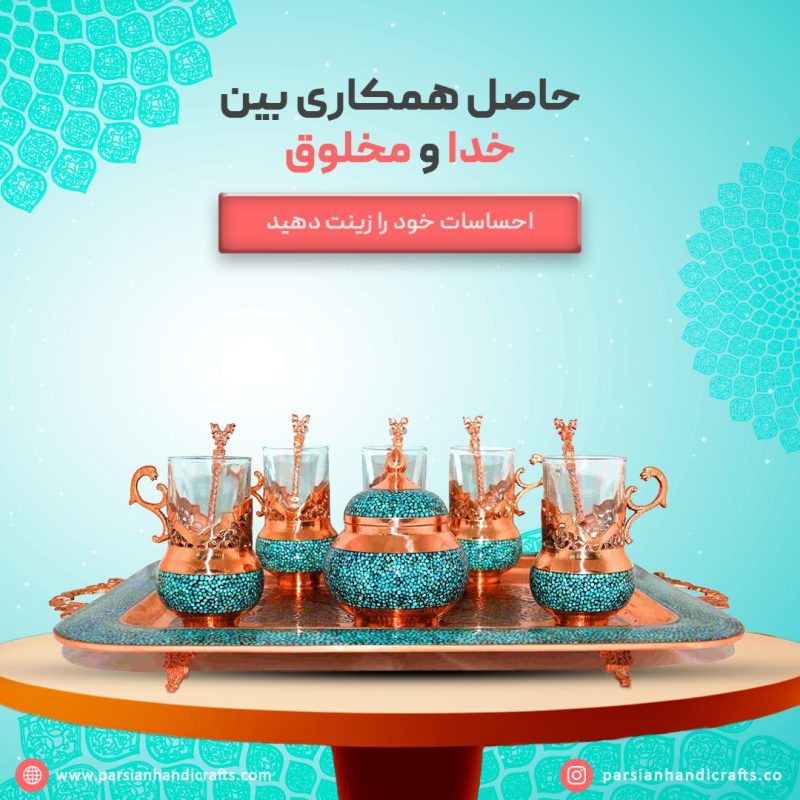
Turquoise tea set
Turquoise wine set
Turquoise hookah
Since each product is made in limited quantities, be sure to contact the store before purchasing.
Price of turquoise carved in Isfahan
The price of turquoise carved dishes or turquoise carved products in general is one of the things that has often become very important given the current conditions. Given the current market fluctuations in relation to the price range of this product, it is not possible to provide accurate information, but it is better to know that choosing copper turquoise carved dishes can be an economical and very cost-effective choice in the first place.
If you are looking to buy a specific turquoise carved product, it is better to first pay attention to the quality of construction and the color of the turquoise of the product. The purity of the stone, the type of arrangement and the dimensions of the stones used are among the factors that affect the price of this product. Apart from examining the body material mentioned earlier, it is better to also consider the density of the stones and the amount of empty space on the dish. The presence of more turquoise stones on different sides of a dish can have a great impact on the price of the product.
To get the wholesale price of Isfahan turquoise carved dishes, contact the Parsian Handicrafts Store.
Turquoise carving shop in Tehran
We do not have a representative in Tehran and buying and selling in other cities is online.
Summary
The art of turquoise carving is an original and ancient art that encompasses part of our history and culture and has a special place among other works of art today with its brilliance and beauty. Turquoise carving is not just a simple task for producing various dishes; it is also a valuable art that is produced with elegance and utmost precision and has a reputation beyond our imagination. If you are looking to obtain these products with exemplary quality and reasonable prices, be sure to visit the specialized sales markets in Isfahan.
Frequently Asked Questions Before Buying
What is turquoise carving and how is it different from other Isfahan handicrafts?
Turquoise carving is an exquisite and relatively contemporary art among Iranian handicrafts that is about 80 years old and its origin dates back to Mashhad, but it has reached its peak of development and flourishing in Isfahan. This art involves placing tiny pieces of turquoise in a precise mosaic pattern on the surface of copper, brass, silver or brassware. Its fundamental difference from arts such as enameling or calligraphy is the use of natural gemstones instead of paint and glaze, which creates a distinctive, vivid and valuable texture. Isfahan turquoise is a combination of the strength of metalworking and the elegance of jewelry making.
Are the stones used in your dishes genuine Neyshabur turquoise?
All products offered by Parsian Handicrafts are made from genuine Neyshabur turquoise. Neyshabur turquoise is considered the most desirable type of turquoise in the world for this art due to its dense structure, stable sky blue color and high resistance to sanding. Unlike market examples that may use Kerman turquoise (with a greener color spectrum and softer texture) or even painted stones, our products have a certificate of authenticity of the stone, which guarantees their Neyshabur origin.
How can you distinguish genuine turquoise-cut vessels from counterfeit ones?
Density and arrangement of stones: In high-quality turquoise-cut vessels (reputable brands), the distance between the turquoise pieces is very small and the black lacquer between them is minimally visible. The stones should fit together like puzzle pieces.
Polished surface: When you run your hand over the body of the vessel, the surface should be completely smooth, glassy, and without steps or roughness. Any bumps indicate poor finishing.
Signature and certificate of authenticity: Genuine vessels must have the master craftsman’s signature or brand engraved on the copper body and come with a warranty card and artistic certificate of authenticity.
Needle Test: Turquoise is very hard. If you run the tip of a needle across the stone and it leaves a line, it is probably pressed plastic or dyed paste.
Why do two turquoise vases of the same size cost different?
Pricing in this art is based on qualitative variables, not just physical dimensions: 1. Stone quality: Using “grade one” Neyshabur stones, which have a uniform blue color and fewer impurities, greatly increases the price. 2. Fineness of arrangement: The finer and denser the stone pieces are arranged, the more time and skill are spent and the more valuable the work is. 3. Quality of copper substrate: The weight of copper used and the thickness of the sheet have a direct impact on durability and price.
Do turquoise vessels turn black in humid areas (north or south)?
Generally no, provided that the protective coating is intact. All of our turquoise vessels are protected with several layers of high-quality German polyester or nano coatings. This transparent layer cuts off the copper’s connection to oxygen and air humidity and prevents oxidation (blackening). Therefore, their use is safe in humid cities, but care must be taken not to hit the container so that this protective layer does not crack.
What are the storage conditions for turquoise containers?
Turquoise is alive and needs care. To maintain its color and shine for a lifetime, it is vital to observe these 4 points:
۱٫ Avoid direct sunlight: UV rays can cause the stone to change color and the polyester layer to turn yellow. Do not place the containers behind sunny windows.
۲٫ Avoid contact with chemicals and cosmetics: Perfume, cologne, hand cream, bleach and acidic detergents are the enemies of turquoise. The penetration of these substances into the stone causes its color to change to a dark, dull green (the death of turquoise), which is irreversible.
۳٫ Keep away from heat: It is forbidden to place the dishes next to a fireplace, heater, or pour boiling water and hot food into them, as this will cause the copper to expand and the stones to separate.
۴٫ Avoid impact: Dropping the dish or a strong impact can cause the lacquer to break and the stones to fall.
What is the best way to clean turquoise-plated dishes?
The easiest and safest way is to use a soft, dry cloth or nano-cloth to remove dust. If more cleaning is needed, you can dampen the cloth slightly with lukewarm water and wipe the surface, but immediately remove the moisture with a dry cloth. Never use dishwashing detergent, abrasive scrubbers, or metal polishing solutions (such as tomato paste or industrial polishes) on the turquoise-plated part.
What are the product warranties?
Parsian Handicrafts products have a 10-year replacement and repair warranty card. This warranty covers the following:
Discoloration or blackening of the copper body (if there is no physical damage to the polyester). Falling stones (provided it is not due to impact). Discoloration of stones (if it is not due to contact with chemicals).
Are these dishes functional or just decorative?
Turquoise products have a dual functional-decorative function. Items such as sugar bowls, chocolate bowls, nut bowls, and pastry bowls are perfectly suitable for dry food (chocolate, gaz, nuts). However, it is recommended to use an inner protective layer (such as cellophane or an inner glass cup) for greasy or wet foods so that washing is not required. Products such as sanboldan, sengab, and Sarahi vases are more decorative and capital-like and add a special splendor to the home window.
How is the product packaged for shipping to the city?
We understand the high sensitivity of these exquisite products. All orders are shipped in completely safe and multi-layered packaging.
Is it possible to buy in bulk for corporate gifts with a dedicated logo?
Yes, we can customize the plaque with your organization’s logo and install it on the box or product base. Also, combination packs in large quantities can be ordered with special cooperation discounts.
What are the most popular turquoise products for dowry and gifts?
Turquoise mirror and candlestick set is the most popular choice for wedding table and bride’s dowry, which symbolizes brightness and happiness. For Mother’s Day, Doctor’s Day or friendly gifts, 20 and 25 cm Sarahi vases and chocolate dishes with doors are ideal options due to their reasonable price and practicality.

